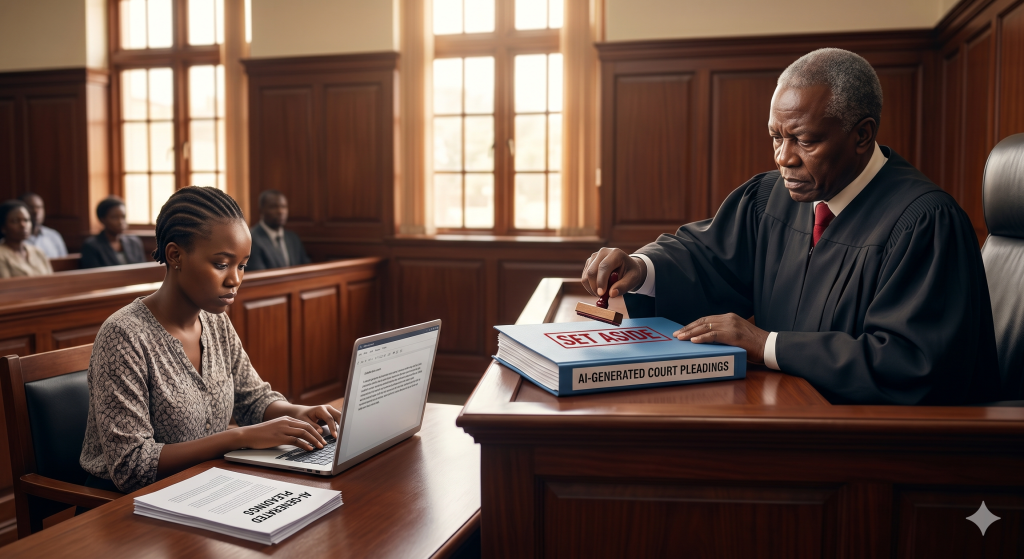
The rise of Artificial Intelligence (AI) has led some self-represented individuals to use these tools to draft their legal documents. However, the rules of litigation in Kenyan courts are strictly prescribed.
In a groundbreaking ruling delivered by Honorable Justice John Chigiti on 17th April 2026, the High Court issued a stern warning to litigants against using AI tools to draft court pleadings.
What’s the gist?
The case involved the Commission on Administrative Justice (CAJ), the constitutional body tasked with investigating public complaints about administrative injustices. The other party was a self-represented litigant who had previously filed numerous complaints with the CAJ.
Alleging that his complaints were ignored, the litigant sued the CAJ in the High Court for violating his constitutional rights. The Court initially ruled in favor of the litigant.
However, the CAJ applied to halt the judgment, arguing they were unable to properly respond to the litigant’s claims because his multiple court documents were confusing. Crucially, the CAJ also alleged that the litigant had used AI tools to draft these documents.
His Defence
In his defence, the litigant argued that he had reviewed, edited, and adopted the AI-generated documents as his own. He asserted that the CAJ provided no forensic evidence, such as metadata, document properties, expert report, forensic report, and particularized falsehoods or identified fabricated citations to support that allegation.
He further argued that his document had no fabricated cases, false citations or invented quotations.
What did the Court say?
The Court stressed that civil proceedings are governed by strict guidelines, specifically the Civil Procedure Rules. These rules exist to ensure court documents are uniform, making it easier for judges to understand the case and identify the core issues to be decided.
The Court held that while the Constitution guarantees access to justice, it does not give self-represented litigants permission to bypass standard drafting rules by using AI. Doing so, the Court noted, creates an unfair advantage, and failing to disclose its use undermines the judicial process.
The Court emphasized that it is nearly impossible to verify the AI prompts used, especially when a litigant is secretive about the tools. As the Court stated, “It does not matter how well the case is argued if the pleadings were illegally drafted.”
What happened next?
Ultimately, the initial judgment in favor of the litigant was completely set aside, along with all related orders. Furthermore, the Court barred him from filing machine-generated pleadings in any other Kenyan court unless specifically permitted by law, and ordered him to bear his own legal costs.
The Real Takeaway: Why You Still Need a Lawyer
This ruling firmly shuts down the growing myth that we no longer need lawyers. Artificial Intelligence is not a trained legal professional; it does not understand the nuances of Kenyan law, the strict formatting of the Civil Procedure Rules, or the strategic foresight required to win a case in court.
While an AI tool might seem like a quick, cost-effective shortcut, relying on it can be disastrous, as this litigant learned when his entire victory was overturned. Even if AI is used to create a rough initial draft, it is absolutely vital to have a qualified professional review, correct, and take legal responsibility for those pleadings.
Ultimately, when it comes to protecting your rights and ensuring your case is actually heard, there is simply no substitute for hiring a qualified, human lawyer